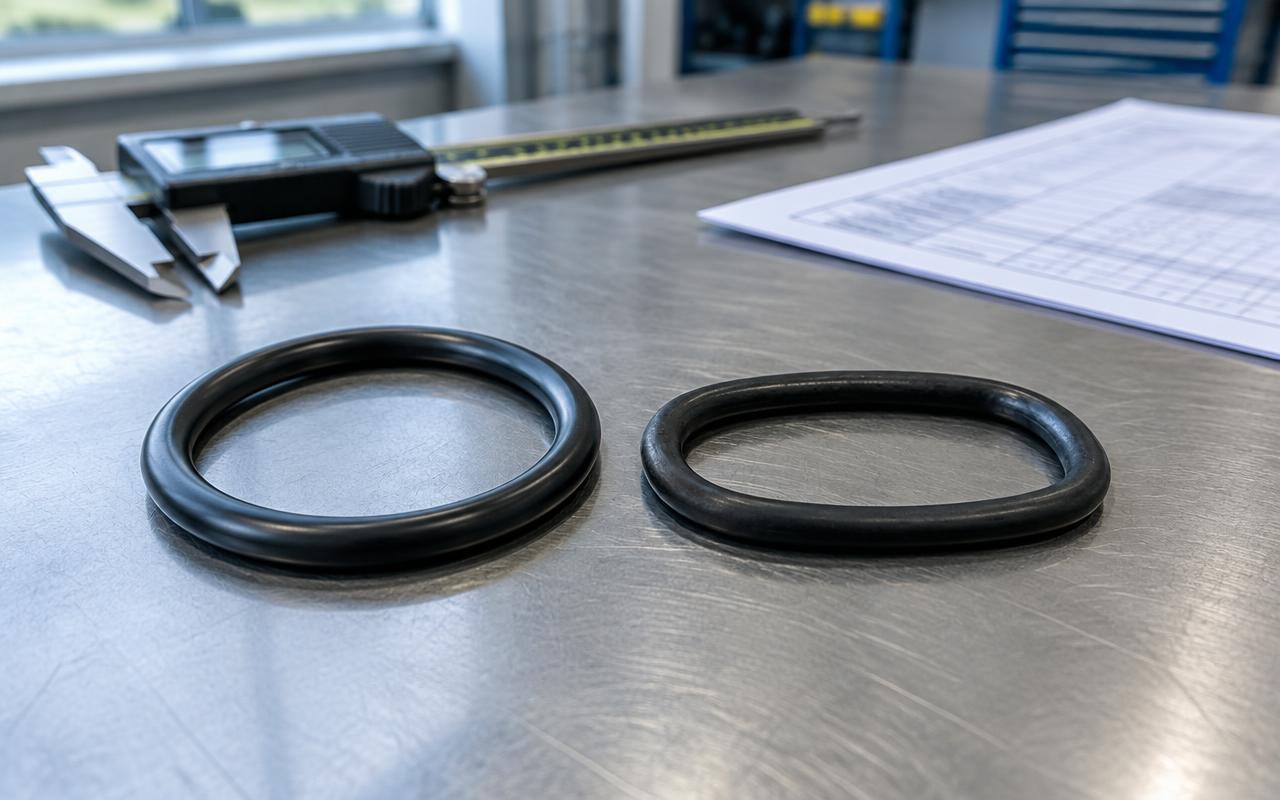
Take an O-ring off a hot flange after a couple of years and find it sitting there like a squashed washer. Round no more, and content to stay that way. That is compression set, and it is one of the commonest reasons a static seal that worked well on day one stops sealing later on.
Rubber seals because it is elastic. Squeeze it into a gland and it pushes back against the mating faces, and that contact force is what blocks the leak path. If the material loses its ability to push back while it is squeezed, the contact force falls away, and eventually the joint leaks with the seal still installed.
What is actually going on
An elastomer is a tangle of long molecular chains held together by crosslinks. When the rubber is compressed, the chains are pushed out of their resting shape and the crosslinks hold them under strain. Left there long enough, especially at temperature, the material slowly rearranges itself into a new equilibrium. Some of the holding force fades while the part is still in the gland, and if the squeeze has been held for long enough, part of the deformation stays after the part is released.
Two related terms get used here. Stress relaxation describes the loss of contact force while the seal remains compressed, which is what matters while the joint is in service. Compression set describes the permanent deformation you can measure after the part has been removed. They are cousins rather than the same thing, but they tend to move together: a compound that relaxes quickly also takes a set quickly.
A useful rule of thumb: a seal needs to recover to within a few percent of its original cross-section to keep working. If an O-ring has taken a set above roughly 50%, the contact force left in the gland is usually too small to trust, whatever the datasheet said.
How the number is measured
Compression set is measured under compression, at temperature, for a fixed time. The standard test in the UK is BS ISO 815-1: test pieces are squeezed to a fixed strain, typically 25%, between plates in an oven, held for 24 or 70 hours, then released and allowed to recover, usually for half an hour, before the thickness is measured. The set is the loss of thickness expressed as a percentage of the amount of squeeze.
The two numbers that matter as much as the result are the test temperature and the test duration. 25% set after 70 hours at 200 °C is a strong result for a fluoroelastomer and a disaster for an EPDM asked to run there. A supplier quoting a single figure without the conditions behind it is not telling you much, so always ask for the temperature and duration as well.
Typical figures by material
Indicative specification limits for standard commercial grades, tested at a temperature each material is expected to work at:
- NBR (nitrile): around 15 to 25% after 70 hours at 100 °C
- HNBR: around 20 to 30% after 70 hours at 150 °C
- EPDM (peroxide cured): around 25 to 30% after 70 hours at 125 to 150 °C
- FKM (fluoroelastomer): around 15 to 25% after 70 hours at 200 °C
- VMQ (silicone): around 30 to 40% after 70 hours at 200 to 225 °C
- FFKM (perfluoroelastomer): around 30 to 50% after 70 hours at higher temperatures still, depending on grade
Silicone and FFKM give higher numbers than FKM on paper, yet both are excellent seal materials in the right service. The figures are only meaningful against the temperature the part will actually see. A silicone seal running at 180 °C with a 35% set figure is fine. An NBR seal with a 20% set figure is irrelevant if the application cycles to 130 °C, because the material is being run past its working range and the set figure was never measured there.
What causes it in service
Most compression set problems trace back to one of a short list:
- Temperature. The single biggest driver. Set rates roughly double for every 10 to 15 °C rise, so a seal rated to 100 °C and run at 120 °C takes a set several times faster than the datasheet suggests.
- Under-cured parts. A compound that has not been cured fully, or a silicone that missed its post-cure, has a crosslink network that is still settling. These parts take a set far faster than a properly cured one, sometimes with nothing visible wrong with them.
- Too much squeeze. Designing a gland with 30% or more squeeze puts the material deeper into strain than the test conditions assume. More squeeze is not more sealing; beyond about 25% on a static O-ring it usually just shortens the life of the seal.
- Gland fill. If thermal expansion or tolerances leave the gland over-full, the material has nowhere to go and the contact pressure behaves unpredictably as the set develops.
- Chemical attack. Steam, some acids and certain oils harden or soften specific compounds and accelerate set. EPDM in mineral oil, or NBR in hot steam, will not match any datasheet figure.
- Time. Set is cumulative. A seal designed for a five-year service life is a different proposition from the same compound in a joint that gets opened annually.
Specifying against it
The practical steps are straightforward.
Match the material to the continuous service temperature first, with margin, rather than to the peak excursion alone. Choose the gland geometry for the squeeze you actually want, typically 15 to 25% on the cross-section for a static O-ring, and check the gland fill worst case, not nominal. Where the service life is long or the temperature is high, ask the compounder for the set figure at your temperature and duration rather than at the catalogue conditions.
For silicone parts destined for long service at temperature, a post-cure is worth specifying. It drives off volatile residues and stabilises the crosslink network, and it is the difference between a set figure that reads well on paper and one that holds up in the gland.
Finally, if a returned seal has flattened, measure it. Comparing the recovered cross-section against the moulded dimension tells you how far the set has progressed, and cutting the part open usually shows whether the problem is heat, cure state or squeeze. It is often the fastest diagnostic on the bench, and it is much cheaper than redesigning a joint on suspicion.
Sending us a requirement
If you have a joint that is running hot, or a seal that has come back flat, send us the drawing and the service conditions. We can advise on material selection and gland design as part of the enquiry, and the moulded parts come back with the cure state and dimensions checked.