A gasket is the cheapest part of a flanged joint and the one that gets blamed when it leaks. That is unfair, because many gasket failures are specification or installation failures rather than manufacturing failures. The right material, at the right thickness, with the right finish, can provide years of reliable service. The wrong material can fail the first time the temperature spikes or the bolt load relaxes.
This post is a practical run through the gasket material families we cut from most often, and the questions that narrow the choice.
Start with the joint, not the material
Before anyone opens a gasket catalogue, we need to know what the joint is actually doing. The material is the answer to a set of conditions, not a starting point.
The operating temperature range matters more than the peak temperature. A gasket that sees 400 °C for ten minutes and 40 °C for the rest of its life is a different problem from one that sits at 250 °C continuously.
The fluid matters. Steam, oil, acids, solvents and potable water each rule materials in or out. A grade that is excellent in steam may be useless in a hydrocarbon, and vice versa.
The pressure and flange type decide how much load the gasket has to carry. A raised-face flange with plenty of bolt load can use a wider range of materials than a low-bolt-load cover where the gasket has to conform to rough or uneven surfaces.
Flange condition and surface finish matter too. A thin, relatively hard gasket on a damaged or uneven flange may not develop an effective seal, while a more conformable material can accommodate greater surface irregularity.
Finally, the life requirement and inspection access matter. A gasket inside a gearbox that is opened every year is a different choice from one buried in a pipeline that has to last a decade.
Compressed fibre / rubber-bonded fibre (CNAF)
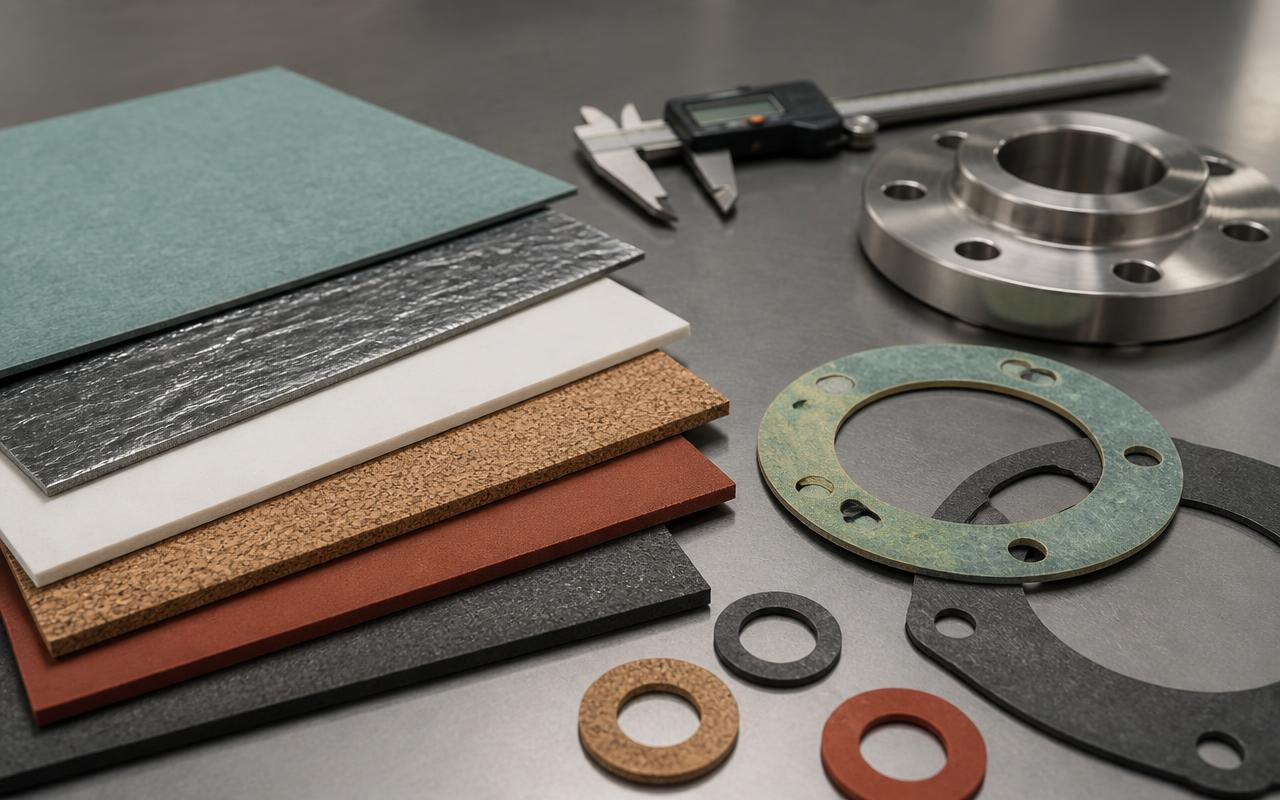
Compressed non-asbestos fibre, or CNAF, is the default engineering gasket sheet for a reason. It is affordable, widely available, mechanically suitable for a wide range of flange applications, and chemically compatible with a broad range of oils, fuels, water and steam. The "rubber-bonded fibre" family - including well-known Klingersil-type materials - is part of the same family: compressed fibre sheet held together with an elastomer binder system that gives it its fluid and temperature character.
Different grades use different fibre/filler and binder formulations to suit steam, oils, fuels, water and other media. Depending on grade, CNAF materials can tolerate relatively high temperatures, but maximum and continuous operating temperatures vary significantly with pressure, medium and gasket construction. It is not suitable for aggressive acids or strong solvents, and it has more creep relaxation than graphite or PTFE under cyclic loading, so long-term bolt load retention needs checking on critical joints. Like any fibre sheet, it needs a clean cut and a properly torqued flange to perform.
Specifying "rubber-bonded fibre" without a grade is not enough; the right grade for the fluid and temperature is what matters.
Graphite
Graphite sheet is the material you move to when temperature or chemical resistance rules out fibre. It handles steam, most chemicals and thermal cycling exceptionally well. Temperature ratings are grade- and atmosphere-dependent; figures such as −200 °C to +550 °C may be quoted, but maximum and continuous operating temperatures depend on the supplier, the grade, the medium and the joint conditions.
Reinforced graphite, usually with a stainless steel foil or tang insert, is used where pressure or handling would otherwise damage the sheet. The reinforcement stops the gasket blowing out under load and makes it easier to handle during assembly.
Graphite is more expensive than CNAF and more demanding to cut cleanly, particularly on small or intricate gaskets. Because graphite is electrically conductive, galvanic corrosion needs consideration where it is coupled with susceptible metals in the presence of an electrolyte. For demanding steam and chemical plant applications, though, it is a well-established choice.
PTFE
PTFE sheet is one of the most chemically resistant gasket materials in common industrial use. There is very little that attacks it, and it is available in virgin grades, filled grades with glass or carbon, and expanded forms that are more conformable under low bolt load.
Its weakness is cold flow. Virgin PTFE creeps under sustained bolt load, so the joint can lose compression over time. Filled and expanded grades reduce this substantially, and for critical chemical applications they are usually worth the extra cost.
PTFE is the material we reach for when the media is aggressive and nothing else is chemically safe. Pharmaceutical, chemical-processing and food-contact applications are common, with grades available to meet relevant regulatory requirements.
Cork and cork-rubber
Cork-rubber is the conformable, low-load option. It seals well against cast or stamped covers that are not perfectly flat, and it takes less bolt load to compress than fibre or graphite. That makes it ideal for sump covers, gearbox lids, transformer gaskets and anywhere the flange is thin or lightly loaded.
The rubber binder gives it oil resistance and some fuel resistance, while the cork gives it compressibility. Temperature range is modest - typically up to +120 °C - so it is not a high-temperature material. Within its envelope, though, it is hard to beat for cost and ease of use.
Silicone sponge and solid sheet
Silicone sheet gaskets are used where temperature range, weathering or biocompatibility is the priority. Solid silicone handles −60 °C to +230 °C, while closed-cell silicone sponge is used for low-load environmental sealing in enclosures, lighting and electronics.
Silicone is not a high-pressure flange material. It tears easily and has comparatively low mechanical strength. Where it wins is in UV, ozone and temperature resistance, and in medical or food-contact applications where the material has to be inert and clean.
EPDM, nitrile and neoprene sheet
These are the rubber sheet materials most people recognise. EPDM for water, steam and outdoor use. Nitrile for oil, fuel and hydraulic service. Neoprene for weathering, marine and general industrial work where moderate oil resistance is useful.
They are cut from sheet rather than moulded, so they suit larger or lower-quantity gaskets where a moulded rubber part would be uneconomic. Thickness, hardness and fabric reinforcement can all be specified to suit the load and the flange.
Insertion rubber - fabric-reinforced sheet - is worth a specific mention. The fabric layer stops the rubber extruding under flange pressure, so it can be used in higher-pressure gasketing than unreinforced rubber sheet.
Vermiculite and metal-reinforced
For demanding high-temperature and fire-safe applications, vermiculite-based and metal-reinforced gaskets are an option alongside other specialist constructions. These materials are designed for exhaust flanges, turbines and fire seals where the joint has to stay intact under severe thermal and mechanical stress.
They are specialist materials with specialist installation requirements. Torque, flange finish and gasket stress all need to be controlled carefully, and the supplier's installation guidance should be followed.
Foam and sponge
Open-cell and closed-cell foams are not flange gasket materials in the traditional sense, but they are widely used for environmental sealing, dust sealing and low-pressure splash protection. The choice between PU, EPDM and silicone foam depends on temperature, compression set resistance and whether the seal needs to be UV-stable.
What to send with the enquiry
The most useful information is the service conditions, not just the drawing. We need temperature, pressure, fluid, flange type, bolt load or torque, and any standard the gasket has to meet. If there is an existing material that has failed, tell us how it failed - extruded, crushed, chemically attacked, thermally degraded - because the failure mode usually points straight at the right replacement family.
A final point on standards
Gasket materials and their properties may be specified against standards such as BS 7531 for rubber-bonded fibre jointing and ASTM F104 for the classification of non-metallic gasket materials. Other material, dimensional and application-specific standards may also apply depending on the gasket and industry. If your drawing calls out a particular standard or material specification, send it with the enquiry so we can match the requirement accurately.
Gasket selection is not glamorous, but it is where a lot of leakage problems start. Send the drawing and the conditions, and we will match the material to the job rather than the job to whatever sheet happens to be on the shelf.